The Sun goes
out over Dunedin.
On the afternoon of Wednesday 22 July 2028, the shadow of the Moon will pass over the southeastern coast of New Zealand's South Island. Dunedin sits on the centre line. The last total solar eclipse visible from the South Island was in 1163; the next won't be until 2068.
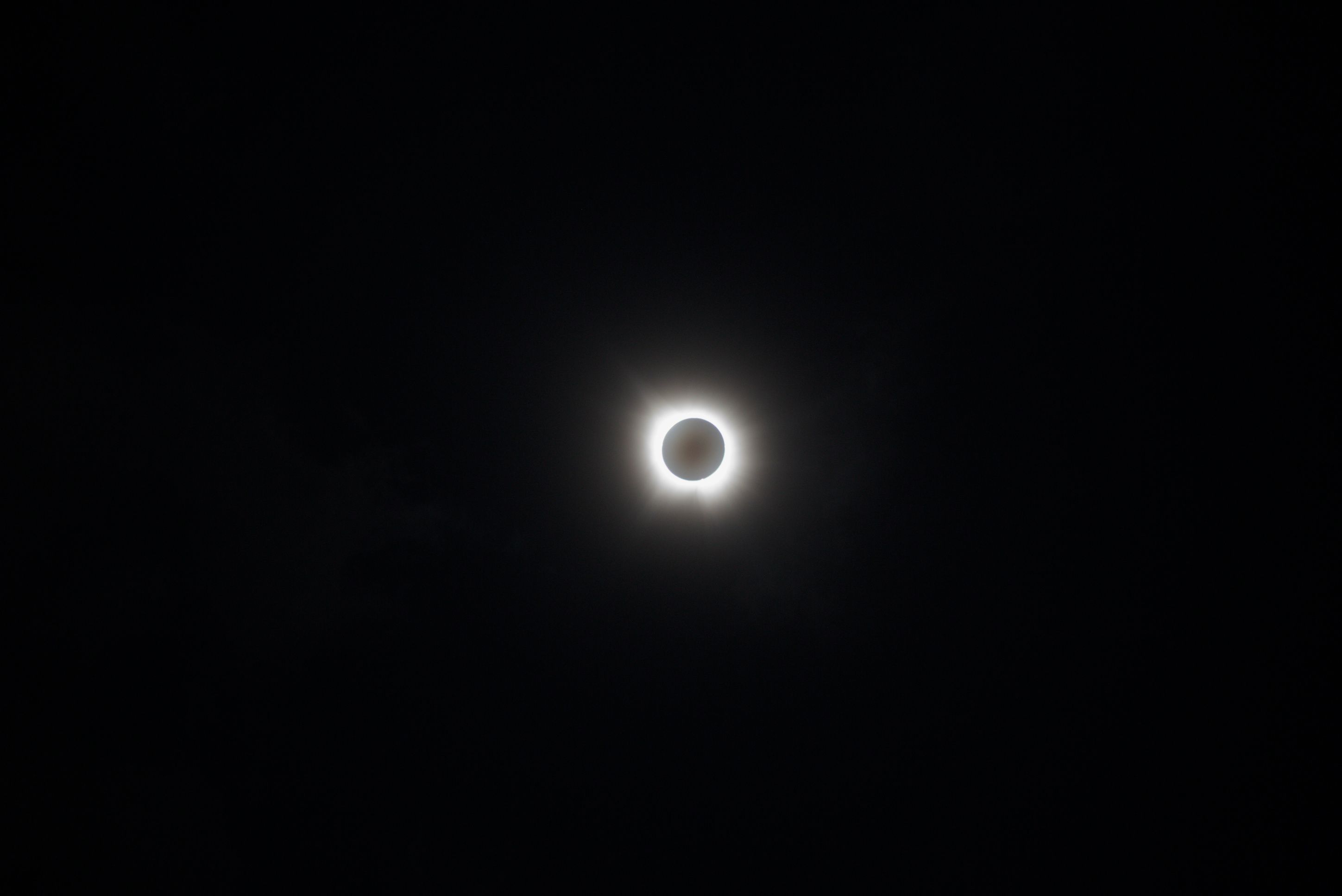
The sky will get dark
in the middle of the afternoon.
As totality approaches, the air temperature drops noticeably. A bright corona — the white pearly halo created by the hot gases in the Sun's atmosphere — appears around the silhouetted Moon. Some stars and planets become visible. Animals, birds, and people often change their behaviour in response.
For two minutes and fifty-one seconds, the Sun's normally invisible outer atmosphere is on full display. Then daylight returns as quickly as it left.
Looking directly at the Sun without proper eclipse eye protection — even during the partial phases — will cause permanent retinal damage. ISO 12312-2 certified eclipse glasses or a properly filtered telescope are required for everything except the brief 2:51 of totality itself.
The afternoon of 22 July 2028.
Eight good spots
around Dunedin.
On the Otago coast, anywhere between Maheno and the Nuggets Lighthouse will experience totality. Dunedin sits squarely on the centre line. The list at right is a starting point — the further north-east or south-west you go from town, the closer to the path edge you get and the shorter your totality.
Path data: NASA Espenak — 2028 Jul 22 path table. Centerline interpolated linearly between 2-minute samples.
What's happening, exactly?
A solar eclipse occurs when the Moon passes between the Earth and the Sun, blocking part or all of the Sun's light. They only happen at new moons, and the Moon's shadow always travels west to east across the Earth's surface.
The Moon completely covers the Sun, and it gets dark as if it were night for a short period. This is the most spectacular type — and what Dunedin sees in 2028.
Only a portion of the Sun is obscured by the Moon.
The Moon covers the centre of the Sun, leaving a ring of the Sun's outer edges visible — often called a 'ring of fire'.
Two to five solar eclipses happen each year worldwide, with a total eclipse roughly every eighteen months. Visibility is the catch — Earth is 70% ocean and the Moon's shadow is only about 150 km wide, so most eclipses pass over open sea.
At any given location, a total eclipse recurs on average every 366 years. The last one over the South Island was in 1163; the next after 2028 won't be until 2068. This one is a once-in-many-lifetimes event for Dunedin.
Things you can only do during totality.
The Sun's outer atmosphere becomes visible during totality, revealing structures and behaviour that are normally hidden.
Flares, prominences, and the Sun's effect on space weather.
Stellar light bending near the Sun — first measured during the 1919 eclipse.
Earth's atmosphere responds rapidly to the loss of sunlight; the corona shadow gives a controlled experiment.
Emerging research on the psychological and physiological effects of totality.
Eclipse records help calibrate our understanding of Earth's rotational changes over centuries.
Around the eclipse.
We're planning a programme of public events leading up to and including 22 July 2028 — local talks, workshops, contests, and pre- and post-eclipse tours. Details will be added here as they're confirmed.
Get in touch about 2028
Questions about viewing the eclipse, organising a group, or running an event in the lead-up? The committee can help. Drop us a line — we're putting plans together now.